
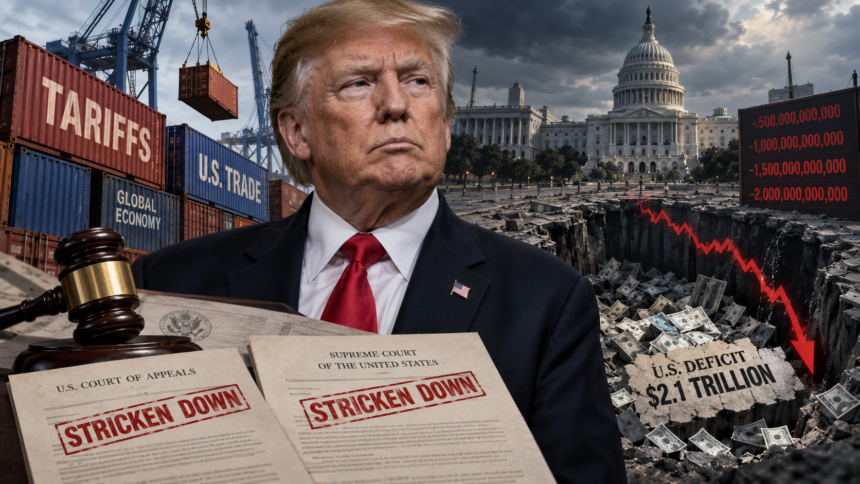
A Supreme Court defeat, a 150-day legal patch, a second court loss, and $100 billion in refunds: the untold story of how America’s tariff regime unraveled — and blew a hole in the federal budget.
Most people know Donald Trump’s tariffs made headlines in 2026. Fewer know just how many times the legal ground shifted underneath them — or how directly that legal chaos is now driving one of the largest deficit blowouts in recent U.S. history.
Round one: the Supreme Court says no
On February 20, 2026, the Supreme Court ruled in Learning Resources v. Trump that the tariffs Trump had imposed under the International Emergency Economic Powers Act (IEEPA) were unlawful — the law, the Court held, never actually gave presidents the power to impose tariffs in the first place. It was a sweeping defeat for a policy that had generated a major share of federal tariff revenue for nearly a year.
Trump didn’t wait. Within days, on February 24, his administration pivoted to a different legal authority — Section 122 of the Trade Act of 1974, which lets a president impose temporary duties of up to 15% to address balance-of-payments problems, for a maximum of 150 days. He set the new global surcharge at 10%.
Round two: the replacement gets struck down too
The patch didn’t hold either. In May, the U.S. Court of International Trade ruled the Section 122 surcharge unlawful as well. The Federal Circuit stayed that ruling on June 11, letting collection continue while the appeal played out — importers had already paid roughly $25 billion in the surcharge by that point, with, in the words of one trade law firm, “the meter” still running.
It didn’t matter in the end: Section 122’s statutory 150-day clock ran out on its own, expiring at 12:01 a.m. on July 24, 2026. The administration immediately layered in yet another mechanism — Section 301 duties of 10–12.5% on goods from 60 countries — while Section 232 tariffs on specific sectors like steel and autos remained untouched throughout. The overall effective U.S. tariff rate, which peaked around 11.0% in April — the highest since 1943 — settled to roughly 8.2% after Section 122 lapsed.
The bill comes due
All that legal whiplash carries a price tag, and it’s landing in the federal budget right now. The Congressional Budget Office’s updated numbers show fiscal year 2026’s deficit is on track to hit $2.1 trillion, up sharply from the $1.9 trillion projected back in February — before the Supreme Court ruling. Tariff and customs-duty collections are now running about $250 billion below that February baseline, and the government has already refunded roughly $100 billion in duties collected under the invalidated IEEPA authority.
The damage shows up starkly in the month-by-month numbers. In July 2026 alone, customs refunds actually exceeded new collections — $36 billion paid out against just $26 billion collected, a net $9 billion outflow in a single month. The Committee for a Responsible Federal Budget noted the government borrowed $431 billion in July alone, or roughly $6 billion every single day. Corporate tax receipts, meanwhile, have fallen 23% for the year, adding further pressure even as individual income and payroll tax collections came in $75 billion ahead of projections.
The trade-off nobody’s advertising
Here’s the twist most coverage has missed: the CBO’s own analysis suggests the Supreme Court’s ruling — despite blowing up the deficit — actually makes some economic indicators look better, not worse, estimating it modestly lowers both inflation and unemployment relative to a world where the IEEPA tariffs had stayed in place. In other words, the same ruling that’s costing the Treasury hundreds of billions in lost revenue may be quietly easing price pressure on households at the same time the Fed is deciding whether it needs to raise rates to fight that very inflation (see our companion piece on Kevin Warsh and the Fed).
Importers, for their part, are stuck navigating a fourth tariff regime in under a year — and bracing for the possibility that even the current Section 301 duties could face their own legal challenge before 2026 is over.