
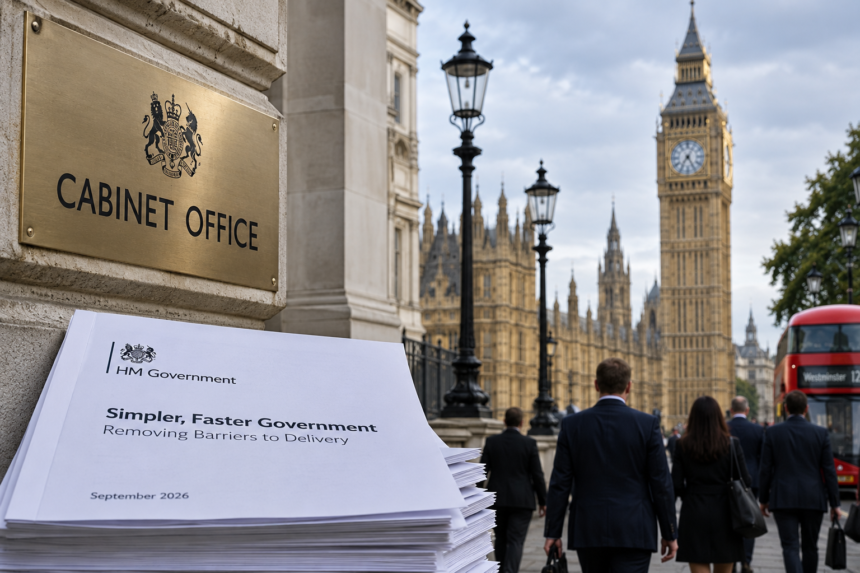
UK ministers have been told to make decisions faster, reduce reliance on formal public consultations and be prepared to accept greater legal risk under a new approach unveiled by the government on Monday.
- Ministers are being told that consultation should no longer be the default
- Can the government legally make a decision without asking the public?
- Why does the government want fewer consultations?
- Ministers may also accept higher levels of legal risk
- Why could that be controversial?
- Judicial review is the third part of the plan
- Does this remove the courts’ power over ministers?
- Thousands of consultation requirements could eventually be reviewed
- What changes for the public immediately?
A joint letter issued on September 7 by Chancellor John Healey, First Secretary of State Louise Haigh and Attorney General Ellie Reeves sets out what ministers describe as an attempt to remove administrative barriers that slow government decision-making.
The changes cover three particularly sensitive areas: public consultations, legal advice and judicial review.
But the announcement does not mean ministers can simply ignore the public, disregard the law or prevent courts from reviewing government decisions.
So what is actually changing?
Ministers are being told that consultation should no longer be the default
One of the clearest parts of the new policy concerns government consultations.
Departments frequently launch consultations before changing regulations, introducing legislation or altering public policy. These can invite responses from businesses, charities, industry groups and members of the public.
The government argues that the process has become too routine.
In Monday’s letter, ministers said there is no general legal requirement for government to consult every time it makes a policy decision and that the default should instead be for ministers to make decisions and act.
Formal consultations would still take place where legislation requires them, where failing to consult would clearly be unfair, or where ministers decide that external input is necessary.
That distinction matters.
The government is not abolishing public consultation. It is attempting to reduce circumstances where departments hold consultations simply because similar consultations have traditionally been carried out.
Can the government legally make a decision without asking the public?
Sometimes, yes.
UK governments are not subject to a universal requirement to consult the public before every policy decision.
But there are circumstances where consultation is legally required.
The House of Commons Library explains that a duty to consult can arise because legislation specifically requires it. A duty can also arise when a public body has made a clear promise to consult, has established a consistent practice of consultation, or where failing to consult would be obviously unfair in particular circumstances.
That means Monday’s announcement does not eliminate existing statutory obligations.
If Parliament has passed a law requiring consultation before a particular decision, ministers cannot override that requirement simply by referring to the government’s new policy.
The government’s letter acknowledges this, saying formal consultation should continue where there is a statutory requirement or where fairness demands it.
Why does the government want fewer consultations?
The government’s argument is largely about speed.
Ministers say Whitehall has accumulated layers of administrative procedure that can delay policies and infrastructure projects.
Monday’s letter describes what it calls a “consultation culture” in which a mechanism originally intended to gather useful outside information can become a cause of delay.
This is not an entirely new direction.
Earlier this year, ministers announced plans to identify unnecessary reporting and consultation requirements across Whitehall as part of a broader effort to simplify government decision-making.
The latest announcement goes further by explicitly telling ministers that formal consultation should not automatically be considered necessary.
Ministers may also accept higher levels of legal risk
Perhaps the most politically significant part of the letter concerns legal advice.
Government lawyers routinely assess whether a proposed policy could face a successful legal challenge.
But legal advice is rarely as simple as declaring a policy definitely legal or definitely illegal. Lawyers may instead assess the likelihood that a particular interpretation would survive a challenge in court.
The government now says that, where there is a tenable legal argument, ministers should be able to proceed even where lawyers believe the risk of losing a legal challenge is high.
The letter says ministers should feel empowered to accept higher levels of legal risk when they believe doing so is justified.
That does not amount to permission to knowingly break the law.
The same document explicitly states that government must continue to act within the law.
Instead, the change concerns situations in which the law is uncertain and there are competing interpretations.
Why could that be controversial?
The distinction between taking a legal risk and acting unlawfully can become politically important.
Governments regularly make decisions that are later challenged through judicial review.
A court may ultimately decide that a minister misunderstood the law, failed to follow a required procedure or exercised a power improperly.
Under the new approach, ministers are being encouraged not to abandon a policy merely because government lawyers believe litigation is likely.
The Attorney General’s existing guidance already recognises legal risk as something government lawyers assess when advising ministers. The new approach is expected to update that framework further.
Critics may argue that encouraging ministers to tolerate more legal risk could lead to more disputes in court.
Supporters are likely to argue that an elected government should not become paralysed simply because a policy might face litigation.
Judicial review is the third part of the plan
The government is also pursuing further changes to judicial review.
Judicial review allows courts to examine whether public bodies, including government ministers, have exercised their powers lawfully.
It is an important constitutional safeguard, but governments have repeatedly complained that challenges can delay major projects.
The latest letter says ministers want to broaden reforms originally aimed at major energy infrastructure so they can cover nationally significant transport, water and other infrastructure projects as well.
Earlier proposals included mechanisms under which Parliament could play a greater role in authorising certain nationally important projects, potentially narrowing the grounds on which they could subsequently be delayed through judicial review.
The government has also been examining whether reforms should extend beyond the existing Nationally Significant Infrastructure Project regime to other major housing, transport and energy developments.
Does this remove the courts’ power over ministers?
No.
Judicial review is not being abolished.
Monday’s letter itself acknowledges that courts perform a core constitutional role in checking whether the executive has exercised its powers lawfully.
Instead, the political argument concerns how far judicial challenges should be able to delay projects that have already gone through extensive government or parliamentary approval.
That debate has appeared repeatedly under governments of different political colours.
For ministers, the concern is that repeated legal challenges can delay infrastructure and increase costs.
For opponents of restricting judicial review, the concern is that reducing access to the courts could weaken an important mechanism for challenging unlawful government decisions.
Thousands of consultation requirements could eventually be reviewed
The changes may extend well beyond Monday’s letter.
The government says it intends during this Parliament to examine thousands of consultation and reporting requirements that have accumulated in legislation.
Its stated starting point will be to consider whether requirements can be repealed rather than automatically retained.
Departments have been told to identify opportunities to remove such requirements through legislation that is already progressing through Parliament or through future bills.
That means the practical effect of the policy may emerge gradually rather than overnight.
Some consultation requirements can be changed through government procedure, while others are written directly into legislation and would require Parliament to amend the law.
What changes for the public immediately?
Probably less than the headline might suggest.
People will still see government consultations.
Businesses, charities and campaign groups will still be invited to respond to major proposals.
And ministers remain legally bound to consult where legislation or public law requires them to do so.
What has changed is the starting assumption inside government.
Instead of officials asking why a department should avoid consultation, ministers are being encouraged to ask whether a formal consultation is actually necessary in the first place.
Combined with a willingness to accept more legal risk and plans to restrict delays from judicial review in major infrastructure cases, it represents a broader attempt to make the executive move faster.
Whether that produces quicker government — or more legal and political conflict — may become one of the more important questions surrounding the reforms.
The real test will come when a minister decides to proceed with a controversial policy without a consultation that would previously have taken place, and someone decides to challenge that decision in court.