
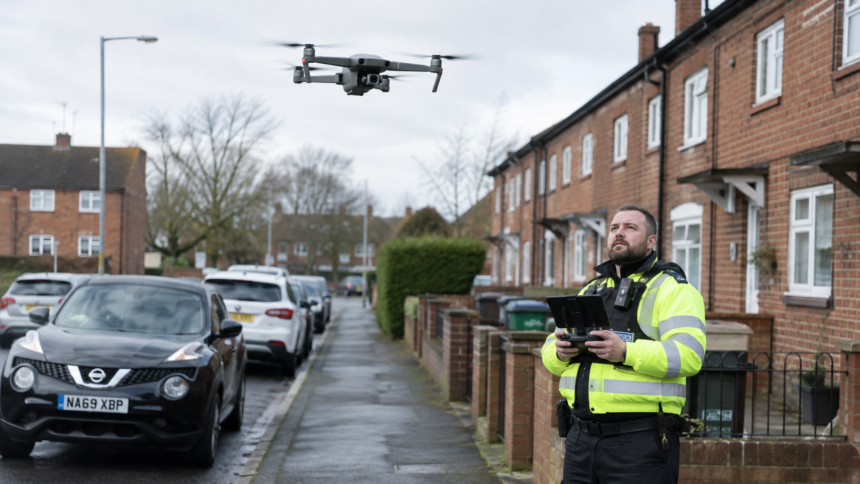
A council drone equipped with thermal imaging technology has been flying over parts of the West Midlands to help officials investigate antisocial behaviour, illegal motorbike use and suspected criminal activity.
- Why Dudley Council is using a drone
- Can councils legally film people from a drone?
- What happens if the drone records an innocent person?
- What about filming someone’s house or garden?
- Councils also have to tell people what they are doing
- There are additional rules for covert surveillance
- Aviation rules still apply
- Could more councils start using drones?
The scheme in Dudley has attracted fresh attention after reports that the aircraft has already recorded around 200 incidents since becoming operational earlier this year.
But the expanding use of drones by local authorities raises a much broader question: how far can a UK council legally go when monitoring people from the air?
The answer is more complicated than simply saying councils can—or cannot—film residents.
Local authorities are allowed to operate drones for legitimate purposes, but their use is surrounded by rules covering privacy, data protection, proportionality, aviation safety and, in some cases, covert surveillance.
Why Dudley Council is using a drone
Dudley Council announced in April that it was deploying a drone as part of a tougher approach to antisocial behaviour.
The authority said reports of antisocial behaviour tend to increase during the warmer months and that the drone would allow officers to reach areas more quickly and collect real-time information.
The aircraft, known as Blade 0,1, can operate at heights of up to 120 metres and the council said it could cover a radius of around 15 miles.
A report published on September 6 said the drone had been used in connection with approximately 200 incidents and had assisted investigations involving suspected drug activity, illegal e-bikes and mopeds and problems involving council properties. The technology has also reportedly helped identify a cannabis-growing operation valued at around £100,000.
Dudley is not the only authority interested in the technology. According to the same report, several other councils have approached Dudley about its experience with the system.
That could make the legal limits surrounding council drones increasingly relevant across England.
Can councils legally film people from a drone?
Yes—but not without restrictions.
Government guidance explicitly includes unmanned aerial vehicles, or drones, within the surveillance systems that local authorities may operate.
However, councils in England and Wales are required to have regard to the Surveillance Camera Code of Practice.
Updated government guidance published on August 25 says surveillance must have a defined purpose and legitimate aim, should not unnecessarily interfere with privacy or human rights, and should be operated transparently with appropriate safeguards.
That means a council cannot simply launch a drone and record residents indefinitely because the technology happens to be available.
Authorities need to be able to explain why surveillance is necessary and why the method being used is proportionate to the problem they are trying to address.
What happens if the drone records an innocent person?
This is one of the biggest complications with aerial surveillance.
A drone investigating one person or incident can inevitably capture footage of other people nearby.
The Information Commissioner’s Office says organisations operating drones can collect personal information about people who were not the intended subject of the recording.
When an organisation operates the drone professionally, it becomes responsible for the personal data captured and must comply with data-protection law.
Government guidance also says councils should not retain more images or information than are strictly required and must have safeguards governing who can access recordings.
So footage collected from the air does not become information a council can simply keep indefinitely or use for unrelated purposes.
What about filming someone’s house or garden?
Privacy expectations become particularly important when cameras can see into places that are not normally considered public.
The Civil Aviation Authority warns that anyone operating a camera-equipped drone must respect people’s privacy. Recording identifiable people can bring UK GDPR and the Data Protection Act 2018 into play.
The CAA specifically notes that using camera equipment where people reasonably expect privacy—such as inside their home or garden—may breach data-protection law.
The fact that a camera is flying rather than fixed to a wall does not remove those protections.
Councils also have to tell people what they are doing
Transparency is another important part of the rules.
Government guidance says surveillance systems operated by local authorities should be sufficiently transparent that members of the public understand they may be monitored.
Councils should also have documented policies covering how systems such as CCTV, body-worn cameras and drones are deployed and used.
The ICO acknowledges that drones create a particular challenge because people on the ground may not realise they are being recorded—or even know which organisation is controlling the aircraft.
Organisations therefore need to consider how they provide appropriate privacy information when using drones.
There are additional rules for covert surveillance
The situation becomes more sensitive if a council deliberately uses surveillance without the subject knowing.
Covert surveillance by local authorities can fall under the Regulation of Investigatory Powers Act 2000, commonly known as RIPA.
Government guidance says local authorities require judicial approval before certain covert surveillance powers can take effect.
The use of directed surveillance under RIPA is also restricted largely to investigations involving offences carrying a potential custodial sentence of six months or more, with limited exceptions.
This creates an important distinction between openly using a drone to monitor a known public-space problem and secretly following an individual over time.
Aviation rules still apply
Privacy law is only one part of the equation.
A council operating a drone must also comply with aviation regulations.
The government’s updated surveillance guidance specifically tells local authorities to consider whether they have the necessary permissions from the Civil Aviation Authority when deploying drones.
Rules can vary according to the aircraft, where it is flown and the type of operation being carried out.
In Dudley’s case, the council said its aircraft would operate at up to 120 metres—the maximum altitude commonly associated with standard UK drone operations.
Could more councils start using drones?
That appears increasingly possible.
Drones can cover areas that would otherwise require multiple officers, reach locations quickly and provide aerial or thermal imagery that ordinary CCTV cannot.
For councils struggling with illegal motorbikes, fly-tipping, antisocial behaviour or problems in large open spaces, the technology is potentially attractive.
But greater capability also creates greater scrutiny.
The government’s surveillance principles require authorities to consider whether a system is genuinely necessary, whether there is a less intrusive alternative and whether the benefits justify the effect on people’s privacy.
Dudley’s experiment may therefore become significant beyond the West Midlands.
If other councils follow, the debate is unlikely to be simply about whether drones work.
It will increasingly be about where legitimate enforcement ends and excessive surveillance begins.