
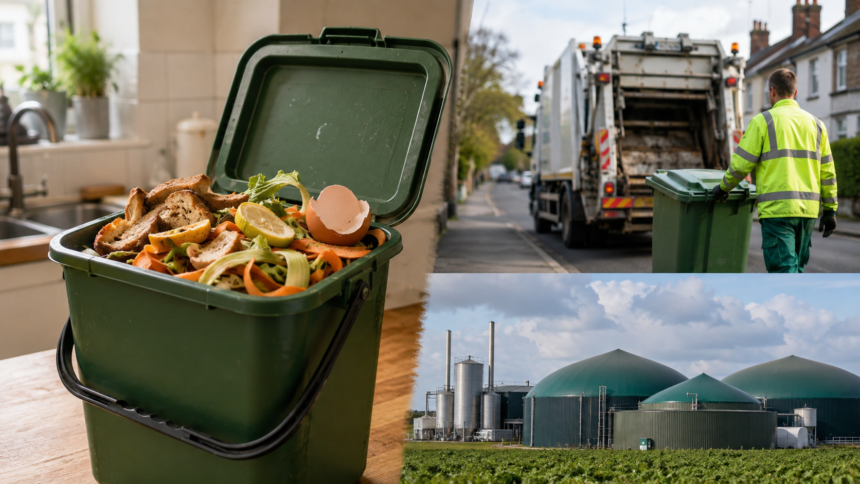
Millions of households put vegetable peelings, leftovers, tea bags and unwanted food into kitchen caddies each week. But once the council collection vehicle disappears down the street, few people know where that waste actually goes.
- Food waste is collected separately from ordinary rubbish
- Collection trucks take the waste to a processing facility
- What is anaerobic digestion?
- Yesterday’s leftovers can become energy
- There is another useful product: digestate
- Some food waste is composted instead
- How much food waste are councils dealing with?
- What should households put in their food caddy?
- Why separating food waste matters
Rather than simply being thrown away, separately collected food waste can begin a process that turns yesterday’s dinner into renewable energy and agricultural fertiliser.
The system is becoming increasingly important as councils across England change the way household waste is collected.
Food waste is collected separately from ordinary rubbish
Since 31 March 2026, waste collection authorities in England have generally been required to provide separate food waste collections from households under the government’s Simpler Recycling rules, although some councils have transitional arrangements allowing later implementation.
Government guidance says household food waste should normally be collected at least once a week and free of charge. Many households receive a small kitchen caddy alongside a larger outdoor container.
Once collected, food waste should remain separate from ordinary black-bin rubbish wherever possible.
That distinction matters because food mixed into general household waste can end up being incinerated or sent to landfill, while separately collected food can be recycled.
Collection trucks take the waste to a processing facility
After completing their rounds, council vehicles deliver food waste either directly to a treatment facility or to a transfer station where larger quantities can be combined before being transported elsewhere.
The exact destination depends on the contract used by each local authority.
Some councils send food waste many miles to specialist plants, while others have treatment facilities relatively close to the communities they serve.
The preferred destination for separately collected food waste in England is an anaerobic digestion plant. Government guidance describes anaerobic digestion as the preferred treatment method where it is practical.
What is anaerobic digestion?
Anaerobic digestion sounds complicated, but the basic idea is relatively simple.
Food waste is placed inside large sealed tanks where microorganisms break down the organic material in an environment without oxygen.
As the material decomposes, it releases a mixture of gases known as biogas.
The process is essentially a carefully controlled and accelerated version of natural decomposition.
Before entering the digestion tanks, food waste may be inspected and processed to remove contamination such as unwanted packaging. It can then be broken down into a form that microorganisms can digest more efficiently.
Yesterday’s leftovers can become energy
One of the main products of anaerobic digestion is biogas.
Biogas can be used to generate electricity and heat. After additional treatment, it can also be upgraded into biomethane, which can potentially be injected into the gas network or used as a transport fuel.
Environment Agency guidance also allows qualifying anaerobic digestion operations to produce biogas for energy generation.
It means food that once appeared to have no value — from potato peelings and stale bread to uneaten meals — can become part of the UK’s renewable-energy system.
There is another useful product: digestate
Energy is only part of the story.
After microorganisms have broken down the food, a nutrient-rich material known as digestate remains.
When it meets the required environmental and quality standards, digestate can be used on agricultural land as a fertiliser or soil improver, returning nutrients from food back to the land where new crops can be grown.
The cycle can therefore look something like this:
Food → household caddy → council collection → anaerobic digestion → biogas + digestate → energy and agriculture.
Some food waste is composted instead
Not every council’s food waste follows exactly the same route.
Where anaerobic digestion is not suitable, food waste can be sent to authorised composting facilities.
This is particularly relevant when food waste is collected together with garden waste. Government guidance says mixed food and garden waste may be treated at facilities such as in-vessel composting plants.
These facilities operate differently from the compost heap someone might keep in their garden because they can process food under tightly controlled conditions.
How much food waste are councils dealing with?
The scale is substantial.
Official Defra figures show that 535,000 tonnes of separately collected household food waste were sent for recycling in England during 2024, up 6.7% from 501,000 tonnes the previous year.
But separately collected food represents only part of what households throw away.
Research published by WRAP estimated that UK households generated around 6 million tonnes of food and drink waste in 2022. Approximately 4.4 million tonnes consisted of parts that could have been eaten.
WRAP estimated that about five million tonnes entered local-authority collections, with roughly 3.9 million tonnes going into general rubbish bins and eventually being incinerated or landfilled at the time.
That helps explain why governments are trying to separate more food from the ordinary waste stream.
What should households put in their food caddy?
Exact instructions can vary, so residents should always check their council’s guidance.
Food collections commonly accept items such as cooked and uncooked leftovers, fruit and vegetable waste, bread, rice, pasta, meat, fish, bones, eggshells and similar kitchen waste.
However, packaging and other non-food materials can contaminate collections.
Government guidance specifically says that plastic packaging and items simply labelled biodegradable or compostable do not automatically belong in household food-waste collections.
Why separating food waste matters
Food waste is unusual because even after people decide they no longer want it, the material still contains energy and nutrients.
Putting it into a separate collection gives those resources a chance to be recovered.
As weekly food-waste services expand, the small kitchen caddy sitting beside the sink is becoming the first stage of a much larger recycling system.
So the next time the council collects a container filled with peelings, scraps and last night’s leftovers, they may not simply be taking rubbish away.
Part of that waste could eventually return as renewable gas, electricity or fertiliser used to grow the next generation of food.