

As of 20 August 2026, nothing about indefinite leave to remain has legally changed. The five-year route for Skilled Workers and the ten-year long-residence route both remain in force, as they were before the government announced its “earned settlement” plan last November. No Immigration Rules implementing the reform have been laid before Parliament. The formal response to a consultation that closed more than six months ago has still not appeared. Ministers say new rules are coming this autumn and that they will apply to people already living in the UK. That is intent, not law.
- The state of play in one box
- What “earned settlement” actually is
- The 10-year baseline replaces the five-year clock
- The four pillars
- What can shorten or lengthen the wait
- Is it retrospective?
- Will it apply to me?
- Skilled Workers already on a five-year clock
- Students and Graduate visa holders switching into work
- The 10-year long-residence route
- Family, refugee and other routes
- Who is unaffected
- Why it hasn’t happened yet
- What to do now
- What happens next
- FAQs
- What are the new rules for ILR in the UK in 2026?
- Is ILR going to be 10 years for a Skilled Worker?
- When will ILR change to 10 years?
- Will the new ILR rules apply to people already in the UK?
- Does time on a Graduate visa count towards ILR?
- Does earned settlement affect people who already have ILR?
- Can I still apply for ILR under the five-year rule?
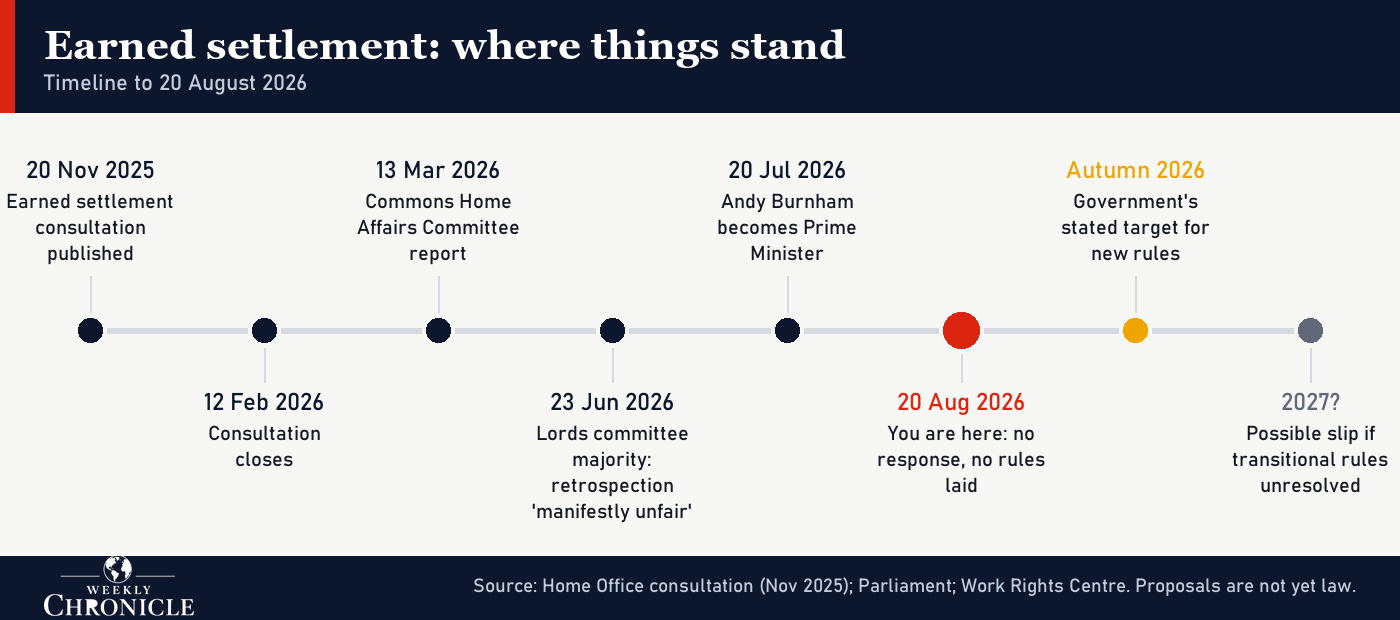
The state of play in one box
- Announced: . The Home Office published its earned settlement consultation and a statement to the Commons.
- Consultation closed: , with more than 200,000 responses reported.
- Home Affairs Committee report: .
- Lords Justice and Home Affairs Committee report: .
- Government response to the consultation: not published as of .
- Impact assessment: not published.
- Immigration Rules laid: none.
- Stated target: autumn 2026. No date has been fixed, and a slip into 2027 is possible.
What “earned settlement” actually is
The 10-year baseline replaces the five-year clock
Under the proposal, the standard qualifying period doubles from five years to ten. Residence still starts the clock. What then moves it faster or slower is what someone has contributed and how they have behaved. The Home Office set this out in its consultation document, “A Fairer Pathway to Settlement”. On the published tables, the arithmetic runs from three years at the fastest to thirty at the slowest on the standard baseline; wider figures circulating in commentary do not appear in the consultation text itself.
The four pillars
The four are residence, contribution, integration and character. A further set of requirements would apply whatever someone’s speed: English at CEFR B2 rather than B1, a pass in the Life in the UK Test, no criminality or suitability concerns, no debt to the public purse, NHS and HMRC debt included, and sustained National Insurance contributions on earnings above £12,570. One piece of the package is already legislated: the March 2026 Statement of Changes raised the settlement English requirement to A-level standard, taking effect a year on, in spring 2027. Everything else still needs Rules that have not been laid.
What can shorten or lengthen the wait
This is the part that decides individual outcomes, and the part where least has been settled. The figures below come from the tables in the consultation document itself. None of them is law. Where more than one factor in the same table applies, only the largest adjustment counts, and any increase takes precedence over a reduction.
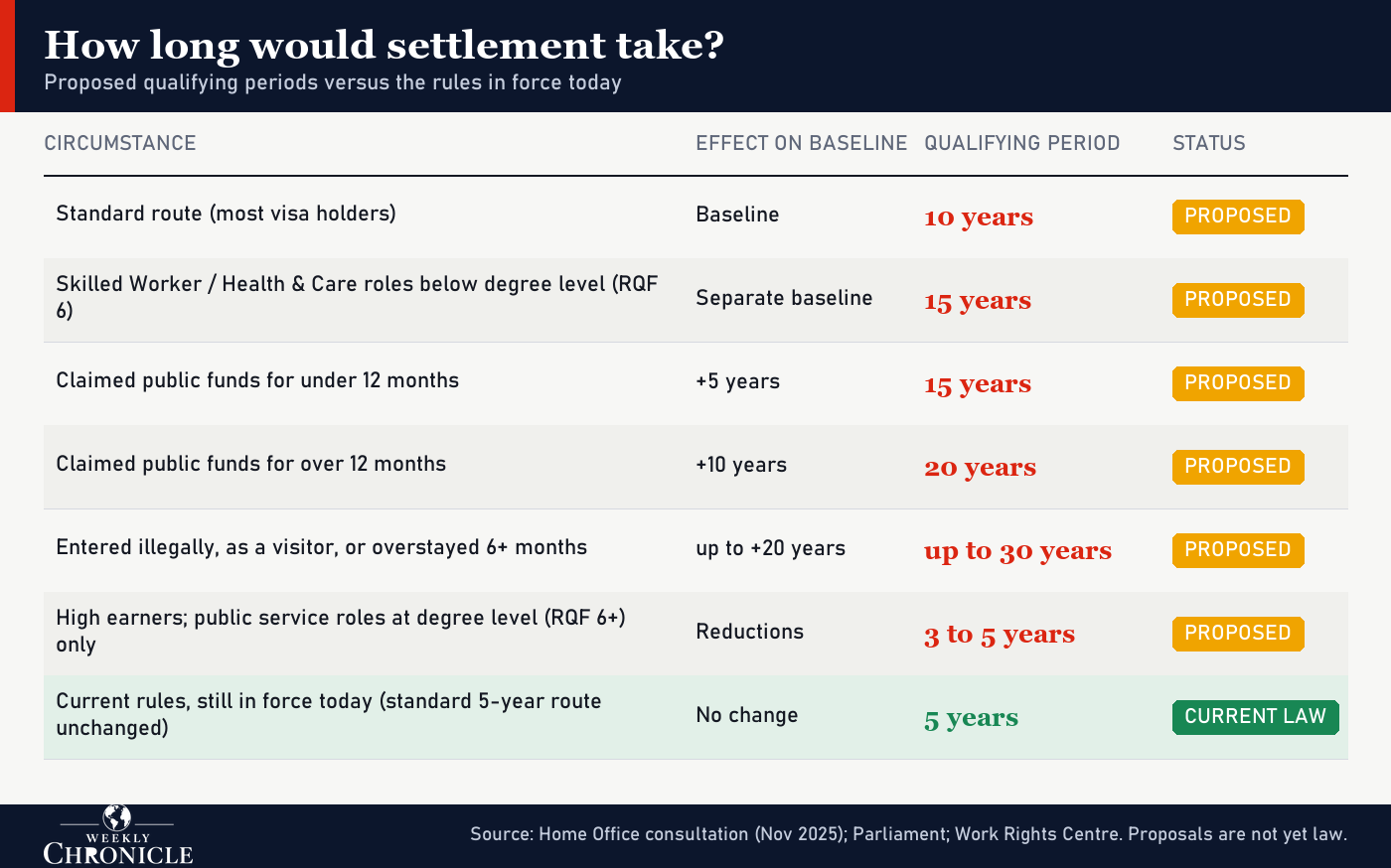
| Circumstance | Effect on baseline | Resulting wait | Status |
|---|---|---|---|
| Standard case, no modifiers | Baseline | 10 years | Proposed, not law |
| Very high earners (taxable income of £125,140 for the three years before applying) | Minus 7 years | 3 years | Proposed, not law |
| Higher earners (£50,270 for the three years before applying) | Minus 5 years | 5 years | Proposed, not law |
| Global Talent and Innovator Founder holders with three years’ residence | Minus 7 years | 3 years | Proposed, not law |
| English at CEFR C1 | Minus 1 year | 9 years | Proposed, not law |
| Public service roles at degree level (RQF 6 or above) for five years; sustained volunteering | Minus 5 years; minus 3 to 5 for volunteering | 5 to 7 years | Proposed, not law |
| Sponsored work below RQF Level 6, including much of the Health and Care route | Separate 15-year baseline | 15 years | Proposed, not law |
| Benefits claimed for less than 12 months | Plus 5 years | 15 years | Proposed, not law |
| Benefits claimed for more than 12 months | Plus 10 years | 20 years | Proposed, not law |
| Illegal entry, arrival on a visit visa, or overstaying by six months or more | Plus up to 20 years | Up to 30 years | Proposed, not law |
Is it retrospective?
The government’s position has not moved. Home Secretary Shabana Mahmood said in early March that the changes would come in the autumn and would apply to people already in the UK, citing the numbers who arrived from 2021 onwards. In her 5 March speech on immigration she argued that the privilege of living in this country forever should be “earned, and not automatic”. She kept the job when Andy Burnham formed a government on 20 July, and the new Prime Minister has not ruled retrospection out on the record.
Three groups sit outside the plan entirely: people who already hold ILR, people with settled or pre-settled status under the EU Settlement Scheme, and people granted status under Windrush arrangements. For everyone else, transitional protection remains undecided. Mike Tapp, then the minister for migration and citizenship, told a Westminster Hall debate on 2 February that transitional arrangements remained under review and that he could not prejudge the consultation. He gave no assurance to people already partway through a five-year clock. Tapp was sacked in July. EIN’s report on the Home Secretary’s comments sets out the stated intention in full.
Will it apply to me?
Skilled Workers already on a five-year clock
Take a nurse who arrived in March 2023 on a Health and Care Worker visa expecting to apply for settlement in March 2028. If her role falls below RQF Level 6, the proposals put her on a 15-year baseline instead of the five she planned for. The public-service reduction would not rescue her either: the consultation restricts it to roles at RQF Level 6 or above, which shuts out most care workers. Whether her existing time counts, and whether anyone already halfway through gets protection, is exactly what the government has not decided.
Students and Graduate visa holders switching into work
The consultation floated stripping time on routes that do not lead to settlement, notably the Student route, out of the qualifying period. Whether Graduate route time itself would count is not clear from the published material. This cohort has already absorbed one change: the Graduate route was cut to 18 months. The window for finding sponsorship is now shorter. We have covered the position of Graduate visa holders with UK-born children separately.
The 10-year long-residence route
People on the ten-year lawful residence route are not obviously better off, because the reform changes what a qualifying period means rather than simply lengthening it. The Home Affairs Committee asked for clear mitigations, including suitable transitional arrangements, for people already in the system.
Family, refugee and other routes
Family routes are in scope. So are dependants: the consultation asked whether they should have to earn settlement in their own right rather than be granted it in line with a main applicant, with an age cut-off for children. Refugee settlement is dealt with in separate measures, which drew objections from more than 100 Labour MPs in early March.
Who is unaffected
Existing ILR holders, EUSS status holders and Windrush cases. Anyone granted ILR before new rules take effect is out of scope.
Why it hasn’t happened yet
The volume is part of it: over 200,000 responses to the consultation, and more than 5,700 written submissions to the Home Affairs Committee. The Home Affairs Committee said in March, in its report on the proposed reforms, that the Home Office “should learn from previous reforms that it is more important to get changes right than to implement them quickly”. It did not oppose retrospection in principle, calling changes for people already in the system “not unprecedented”, but it asked for suitable transitional arrangements. The Lords Justice and Home Affairs Committee, chaired by Lord Foster of Bath, went further in June: a majority of that committee concluded retrospective change would be “manifestly unfair” and might be unlawful, while a minority backed the government. The Lords report also questioned whether the Home Office has the capacity to deliver. Transitional design is unresolved. The Skill Migrants Alliance has been preparing a judicial review. Officials have every reason to get the drafting right first time.
Scale explains the caution. The Work Rights Centre put the number of people on settlement-leading routes at between 2.06 and 2.47 million at the end of 2025, including 890,000 Skilled Workers, 350,000 on Health and Care visas, and up to 593,000 children. The Migration Observatory has modelled settlement numbers expected between 2026 and 2030. Free Movement has argued that a purely prospective change would be worse in some respects. Even the critics disagree with each other.
What to do now
- Confirm the start date on your certificate of sponsorship and work out your current qualifying end date.
- Check whether your ILR application window falls before autumn. If it does, apply under the rules in force.
- Keep evidence of income, your National Insurance record, your English test level and your absences from the UK.
- Absence breaches already cost people settlement under the current rules, and they will matter under any new ones.
- If you are near the English threshold, note the higher requirement already legislated to take effect in spring 2027 and book a test.
- Watch for a Statement of Changes to the Immigration Rules, not press coverage. Nothing binds until it is laid.
- Do not pay anyone promising a guaranteed five-year lock-in.
What happens next
The formal government response comes first, and it will show which modifiers survived. After that, a Statement of Changes to the Immigration Rules. That is the only document that turns any of this into law, and the one that will carry the commencement and transitional provisions. A pre-action letter or a filed judicial review would be the signal that the transitional design has landed badly. Until one of those appears, the current rules stand.
FAQs
What are the new rules for ILR in the UK in 2026?
Nothing has changed yet. The proposal, called earned settlement, would replace the standard five-year route with a 10-year baseline that can shorten to three years or stretch to thirty depending on earnings, English level, benefits use and immigration history. As of 20 August 2026 no Immigration Rules have been laid, so the current five-year and ten-year routes still apply.
Is ILR going to be 10 years for a Skilled Worker?
That is the proposal. Skilled Workers would move from five years to a 10-year baseline, and sponsored roles below RQF Level 6, which covers much of the Health and Care route, would face a separate 15-year baseline. None of this is law yet.
When will ILR change to 10 years?
The stated target is autumn 2026. No commencement date has been fixed, and the timetable already slipped once from an earlier April 2026 signal.
Will the new ILR rules apply to people already in the UK?
Ministers have said they will. Transitional protection has not been decided. A majority of the Lords committee called retrospective change “manifestly unfair”, while the Commons committee accepted the principle but asked for suitable transitional arrangements.
Does time on a Graduate visa count towards ILR?
Unclear. The consultation proposed excluding time on routes that do not lead to settlement, naming the Student route. Graduate route time has not been spelled out.
Does earned settlement affect people who already have ILR?
No. Existing ILR holders, EUSS settled and pre-settled status holders, and Windrush cases are outside the proposals.
Can I still apply for ILR under the five-year rule?
Yes, if you meet the current requirements and apply while the current rules are in force. That is the strongest reason to check your eligibility date now.